Series: Converting a Closed-End Real Estate Fund to an Evergreen NAV (Open-End) Structure
March 16, 2026
Series: Converting a Closed-End Real Estate Fund to an Evergreen NAV (Open-End) Structure
March 16, 2026
Converting a Closed-End Real Estate Fund to an Evergreen NAV (Open-End) Structure, Part 3: Capital Formation
Capital formation is the engine that allows an evergreen or open-end fund to function.
If you read Part 1 and Part 2 of this series, you know that (a) converting a closed‑end fund to an evergreen fund can have significant benefits for sponsors and investors, and (b) any such conversion must include a long‑term capital formation plan.
Fortunately, evergreen funds are powerful capital formation vehicles, particularly in the private wealth channel. Over the past several years, evergreen and semi‑liquid private market vehicles distributed through financial advisors and wealth platforms have grown into a market representing hundreds of billions of dollars of capital. Industry research indicates that semi‑liquid private market funds are now approaching $500 billion in assets, with assets growing by more than 30% over the twelve months through September 2025.[1], [2]
Private wealth investors represent one of the largest untapped pools of capital for private markets, with trillions of dollars expected to move into alternative investments over the coming years. Financial advisors and high‑net‑worth investors are increasingly allocating to semi‑liquid private real estate vehicles, creating a deep and growing pool of capital for sponsors that can access these distribution channels. These allocations are often driven by investor demand for long-term exposure to private assets, NAV-based pricing that is less sensitive to short-term market volatility and portfolio diversification beyond publicly traded stocks and bonds.
Evergreen vehicles are designed to accept new capital on an ongoing basis. That capital can support portfolio growth while also providing liquidity to investors through a structured redemption program. For many financial advisors and high-net-worth investors seeking stable, long-term allocations to real estate, an evergreen NAV-based vehicle fits naturally within that framework. Investors subscribe based on NAV and the portfolio grows over time within a structure designed to accommodate periodic liquidity.
For that reason, many evergreen real estate vehicles are designed with the private wealth channel in mind.
In practice, accessing the private wealth channel typically requires relationships with broker-dealers, registered investment advisers and other wealth platforms that distribute private market investments to their clients. Sponsors seeking to raise capital through these channels often work with placement agents, dealer managers or internal distribution teams that build and maintain relationships with financial advisors and wealth platforms. Once established, these distribution networks can provide a steady flow of capital into evergreen vehicles over time. Structuring an evergreen vehicle to access these distribution channels typically requires multiple share classes and carefully designed distribution arrangements, which will be discussed in the next post in this series.
In addition to traditional distribution channels, some sponsors have successfully raised capital through issuer-direct strategies, particularly in private offerings conducted under Rule 506(c). Digital platforms and online investor outreach have made it easier for sponsors to connect directly with accredited investors without relying on a captive broker-dealer network. While this approach typically requires a different investor acquisition strategy, it can be particularly useful for smaller asset managers seeking to build an initial capital base before expanding into broader distribution channels.
The UPREIT Structure
Structurally, many evergreen real estate vehicles are organized using a REIT and operating partnership structure, commonly referred to as an UPREIT. This structure provides significant flexibility and allows the sponsor to accommodate multiple sources of capital within a single investment program.
In an UPREIT evergreen structure, capital can be raised from a variety of investor channels, including retail and private wealth investors, institutional investors, offshore investors, property contributors through Section 721 exchanges, and co‑investment partners. The structure allows these different forms of capital to coexist while maintaining a unified portfolio and centralized asset management and governance.
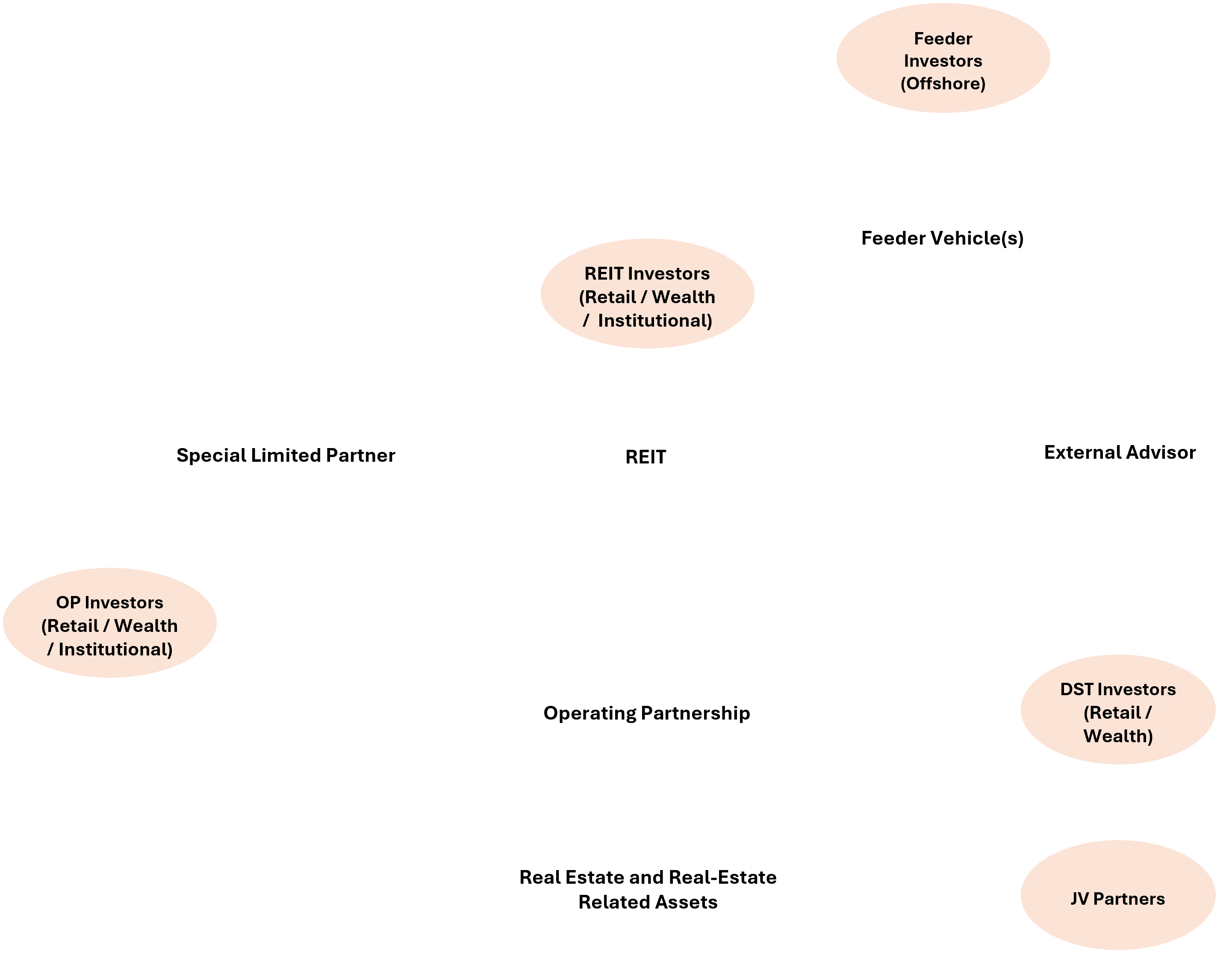
The structure below illustrates how capital from multiple investor channels can be introduced into a single evergreen investment program.
The REIT in the Structure
The UPREIT structure shown above, used by many evergreen real estate vehicles, has the REIT at the top. This approach is particularly common in vehicles designed for distribution through financial advisors and private wealth platforms.
One important reason is tax reporting. Investors in a REIT receive Form 1099 tax reporting, while investors in partnerships generally receive Schedule K-1s. Retail investors and many private wealth investors strongly prefer the simplicity of 1099 reporting, which many financial advisors view as easier for clients to understand and administer. For that reason, placing a REIT at the top of the structure can make an evergreen vehicle significantly easier to distribute through retail and private wealth channels.
However, a REIT is not required for an evergreen structure.
Some sponsors begin with a partnership-based vehicle and later add a REIT once the fund begins raising capital through retail or wealth channels. The governing documents may be drafted from the outset to allow a REIT to be inserted above the partnership at a later stage if the sponsor decides to pursue that strategy. This “springing REIT” concept allows a sponsor to launch an evergreen vehicle without immediately committing to a REIT structure while preserving the ability to add one later if the capital formation strategy evolves toward issuing REIT shares.
Institutional open-end real estate funds often use a different structural approach than retail-oriented NAV REIT vehicles. Many institutional funds, including vehicles in the ODCE (Open-End Diversified Core Equity category), are organized with a partnership at the top of the structure rather than a REIT. In these structures, investors invest directly into a partnership fund that may hold real estate through a REIT subsidiary or directly through property-owning entities.
Historically, many institutional investors have preferred this partnership-first structure because it allows investors to hold partnership interests and receive partnership tax reporting while preserving significant structural flexibility. Sponsors may place a REIT directly beneath the partnership, use a REIT only for certain assets within the portfolio, or omit the REIT layer entirely depending on the characteristics of the assets and the investor base. Where used, the REIT often serves specific tax objectives.
Notwithstanding the foregoing, in recent years a number of institutional investors have invested directly in NAV REITs.
Sponsors designing evergreen vehicles therefore have several structural options depending on their target investor base and capital formation strategy.
The Operating Partnership Level: Structural Flexibility
The operating partnership level of the structure provides additional flexibility. For example, the sponsor can typically receive its performance allocation at the operating partnership level in a tax-efficient manner.
The operating partnership also allows the vehicle to accept property contributions through transactions structured under Section 721 of the Internal Revenue Code. In these transactions, property owners contribute real estate to the operating partnership in exchange for operating partnership units, generally on a tax-deferred basis. These transactions can be particularly attractive to real estate owners with appreciated property who are seeking diversification while deferring taxes. In practice, this concept is not limited to individual property owners. It is often used in connection with affiliated funds or portfolios with appreciated assets, where investors contribute properties held in existing vehicles to the evergreen structure in exchange for operating partnership units rather than selling the assets.
DST Capital
The operating partnership structure has also become increasingly important in connection with Delaware Statutory Trust (DST) programs used in Section 1031 exchanges. The DST market has grown significantly in recent years, with billions of dollars of equity raised annually through DST offerings.[3]
These programs are particularly popular with real estate owners seeking to complete tax-deferred exchanges while transitioning from direct property ownership to passive investment structures.
In practice, DST programs now operate under several different models.
In the most traditional model, the DST investment simply holds the underlying property for a fixed period, often approximately ten years, and then sells the property. Investors must then complete another exchange or recognize taxable gain. As a result, the DST market creates a recurring pool of capital seeking long-term real estate exposure.
In more recent structures, the operating partnership of a NAV REIT affiliated with the DST sponsor may retain an option to acquire the DST interests, with DST investors receiving OP units in a Section 721 exchange. This allows investors to transition from a single-property DST investment into a diversified portfolio of assets.
These structures have become increasingly popular because they offer DST investors a potential path out of the traditional cycle of repeated exchanges, while providing sponsors with access to a large pool of capital seeking long-term exposure to real estate. For sponsors, this creates another important capital formation channel, allowing evergreen vehicles to absorb capital that would otherwise continue cycling through the 1031 exchange market.
Institutional Capital and Co-Investment
As mentioned earlier, institutional investors can also participate in evergreen structures. In fact, in recent years a number of institutional investors have invested directly in NAV REITs.
Institutional investors may also invest at the operating partnership level if that is preferred for tax, governance or other reasons.
The structure can also accommodate co-investment arrangements at the asset level, where institutional partners invest alongside the fund in particular properties.
Share Classes and Distribution
A single evergreen structure can accommodate multiple types of capital while maintaining a unified portfolio of assets. Structuring an evergreen vehicle to access these distribution channels typically requires multiple share classes and carefully designed distribution arrangements, which will be discussed in the next post in this series.
[1] MSCI, The Ascendance and Implications of Evergreen Funds in Private Markets (Mar. 3, 2026) (reporting that semi‑liquid private‑market funds are rapidly approaching $500 billion in AUM and grew more than 30% over the 12 months through September 2025).
[2] Morningstar, State of Semiliquid Funds (Jan. 30, 2026) (reporting approximately $493 billion in net assets for semi‑liquid funds as of Q3 2025, based on Morningstar Direct and SEC filings).
[3] AltsWire, Delaware Statutory Trust Offerings Raise Nearly $5.66 Billion in 2024 (Jan. 12, 2025) (citing Mountain Dell Consulting data on annual DST equity raises).
Capital formation is the engine that allows an evergreen or open-end fund to function.
If you read Part 1 and Part 2 of this series, you know that (a) converting a closed‑end fund to an evergreen fund can have significant benefits for sponsors and investors, and (b) any such conversion must include a long‑term capital formation plan.
Fortunately, evergreen funds are powerful capital formation vehicles, particularly in the private wealth channel. Over the past several years, evergreen and semi‑liquid private market vehicles distributed through financial advisors and wealth platforms have grown into a market representing hundreds of billions of dollars of capital. Industry research indicates that semi‑liquid private market funds are now approaching $500 billion in assets, with assets growing by more than 30% over the twelve months through September 2025.[1], [2]
Private wealth investors represent one of the largest untapped pools of capital for private markets, with trillions of dollars expected to move into alternative investments over the coming years. Financial advisors and high‑net‑worth investors are increasingly allocating to semi‑liquid private real estate vehicles, creating a deep and growing pool of capital for sponsors that can access these distribution channels. These allocations are often driven by investor demand for long-term exposure to private assets, NAV-based pricing that is less sensitive to short-term market volatility and portfolio diversification beyond publicly traded stocks and bonds.
Evergreen vehicles are designed to accept new capital on an ongoing basis. That capital can support portfolio growth while also providing liquidity to investors through a structured redemption program. For many financial advisors and high-net-worth investors seeking stable, long-term allocations to real estate, an evergreen NAV-based vehicle fits naturally within that framework. Investors subscribe based on NAV and the portfolio grows over time within a structure designed to accommodate periodic liquidity.
For that reason, many evergreen real estate vehicles are designed with the private wealth channel in mind.
In practice, accessing the private wealth channel typically requires relationships with broker-dealers, registered investment advisers and other wealth platforms that distribute private market investments to their clients. Sponsors seeking to raise capital through these channels often work with placement agents, dealer managers or internal distribution teams that build and maintain relationships with financial advisors and wealth platforms. Once established, these distribution networks can provide a steady flow of capital into evergreen vehicles over time. Structuring an evergreen vehicle to access these distribution channels typically requires multiple share classes and carefully designed distribution arrangements, which will be discussed in the next post in this series.
In addition to traditional distribution channels, some sponsors have successfully raised capital through issuer-direct strategies, particularly in private offerings conducted under Rule 506(c). Digital platforms and online investor outreach have made it easier for sponsors to connect directly with accredited investors without relying on a captive broker-dealer network. While this approach typically requires a different investor acquisition strategy, it can be particularly useful for smaller asset managers seeking to build an initial capital base before expanding into broader distribution channels.
The UPREIT Structure
Structurally, many evergreen real estate vehicles are organized using a REIT and operating partnership structure, commonly referred to as an UPREIT. This structure provides significant flexibility and allows the sponsor to accommodate multiple sources of capital within a single investment program.
In an UPREIT evergreen structure, capital can be raised from a variety of investor channels, including retail and private wealth investors, institutional investors, offshore investors, property contributors through Section 721 exchanges, and co‑investment partners. The structure allows these different forms of capital to coexist while maintaining a unified portfolio and centralized asset management and governance.
The structure below illustrates how capital from multiple investor channels can be introduced into a single evergreen investment program.
The REIT in the Structure
The UPREIT structure shown above, used by many evergreen real estate vehicles, has the REIT at the top. This approach is particularly common in vehicles designed for distribution through financial advisors and private wealth platforms.
One important reason is tax reporting. Investors in a REIT receive Form 1099 tax reporting, while investors in partnerships generally receive Schedule K-1s. Retail investors and many private wealth investors strongly prefer the simplicity of 1099 reporting, which many financial advisors view as easier for clients to understand and administer. For that reason, placing a REIT at the top of the structure can make an evergreen vehicle significantly easier to distribute through retail and private wealth channels.
However, a REIT is not required for an evergreen structure.
Some sponsors begin with a partnership-based vehicle and later add a REIT once the fund begins raising capital through retail or wealth channels. The governing documents may be drafted from the outset to allow a REIT to be inserted above the partnership at a later stage if the sponsor decides to pursue that strategy. This “springing REIT” concept allows a sponsor to launch an evergreen vehicle without immediately committing to a REIT structure while preserving the ability to add one later if the capital formation strategy evolves toward issuing REIT shares.
Institutional open-end real estate funds often use a different structural approach than retail-oriented NAV REIT vehicles. Many institutional funds, including vehicles in the ODCE (Open-End Diversified Core Equity category), are organized with a partnership at the top of the structure rather than a REIT. In these structures, investors invest directly into a partnership fund that may hold real estate through a REIT subsidiary or directly through property-owning entities.
Historically, many institutional investors have preferred this partnership-first structure because it allows investors to hold partnership interests and receive partnership tax reporting while preserving significant structural flexibility. Sponsors may place a REIT directly beneath the partnership, use a REIT only for certain assets within the portfolio, or omit the REIT layer entirely depending on the characteristics of the assets and the investor base. Where used, the REIT often serves specific tax objectives.
Notwithstanding the foregoing, in recent years a number of institutional investors have invested directly in NAV REITs.
Sponsors designing evergreen vehicles therefore have several structural options depending on their target investor base and capital formation strategy.
The Operating Partnership Level: Structural Flexibility
The operating partnership level of the structure provides additional flexibility.
For example, the sponsor can typically receive its performance allocation at the operating partnership level in a tax-efficient manner.
The operating partnership also allows the vehicle to accept property contributions through transactions structured under Section 721 of the Internal Revenue Code. In these transactions, property owners contribute real estate to the operating partnership in exchange for operating partnership units, generally on a tax-deferred basis. These transactions can be particularly attractive to real estate owners with appreciated property who are seeking diversification while deferring taxes. In practice, this concept is not limited to individual property owners. It is often used in connection with affiliated funds or portfolios with appreciated assets, where investors contribute properties held in existing vehicles to the evergreen structure in exchange for operating partnership units rather than selling the assets.
DST Capital
The operating partnership structure has also become increasingly important in connection with Delaware Statutory Trust (DST) programs used in Section 1031 exchanges. The DST market has grown significantly in recent years, with billions of dollars of equity raised annually through DST offerings.[3]
These programs are particularly popular with real estate owners seeking to complete tax-deferred exchanges while transitioning from direct property ownership to passive investment structures.
In practice, DST programs now operate under several different models.
In the most traditional model, the DST investment simply holds the underlying property for a fixed period, often approximately ten years, and then sells the property. Investors must then complete another exchange or recognize taxable gain. As a result, the DST market creates a recurring pool of capital seeking long-term real estate exposure.
In more recent structures, the operating partnership of a NAV REIT affiliated with the DST sponsor may retain an option to acquire the DST interests, with DST investors receiving OP units in a Section 721 exchange. This allows investors to transition from a single-property DST investment into a diversified portfolio of assets.
These structures have become increasingly popular because they offer DST investors a potential path out of the traditional cycle of repeated exchanges, while providing sponsors with access to a large pool of capital seeking long-term exposure to real estate. For sponsors, this creates another important capital formation channel, allowing evergreen vehicles to absorb capital that would otherwise continue cycling through the 1031 exchange market.
Institutional Capital and Co-Investment
As mentioned earlier, institutional investors can also participate in evergreen structures. In fact, in recent years a number of institutional investors have invested directly in NAV REITs.
Institutional investors may also invest at the operating partnership level if that is preferred for tax, governance or other reasons.
The structure can also accommodate co-investment arrangements at the asset level, where institutional partners invest alongside the fund in particular properties.
Share Classes and Distribution
A single evergreen structure can accommodate multiple types of capital while maintaining a unified portfolio of assets. Structuring an evergreen vehicle to access these distribution channels typically requires multiple share classes and carefully designed distribution arrangements, which will be discussed in the next post in this series.
[1] MSCI, The Ascendance and Implications of Evergreen Funds in Private Markets (Mar. 3, 2026) (reporting that semi‑liquid private‑market funds are rapidly approaching $500 billion in AUM and grew more than 30% over the 12 months through September 2025).
[2] Morningstar, State of Semiliquid Funds (Jan. 30, 2026) (reporting approximately $493 billion in net assets for semi‑liquid funds as of Q3 2025, based on Morningstar Direct and SEC filings).
[3] AltsWire, Delaware Statutory Trust Offerings Raise Nearly $5.66 Billion in 2024 (Jan. 12, 2025) (citing Mountain Dell Consulting data on annual DST equity raises).
Capital formation is the engine that allows an evergreen or open-end fund to function.
If you read Part 1 and Part 2 of this series, you know that (a) converting a closed‑end fund to an evergreen fund can have significant benefits for sponsors and investors, and (b) any such conversion must include a long‑term capital formation plan.
Fortunately, evergreen funds are powerful capital formation vehicles, particularly in the private wealth channel. Over the past several years, evergreen and semi‑liquid private market vehicles distributed through financial advisors and wealth platforms have grown into a market representing hundreds of billions of dollars of capital. Industry research indicates that semi‑liquid private market funds are now approaching $500 billion in assets, with assets growing by more than 30% over the twelve months through September 2025.[1], [2]
Private wealth investors represent one of the largest untapped pools of capital for private markets, with trillions of dollars expected to move into alternative investments over the coming years. Financial advisors and high‑net‑worth investors are increasingly allocating to semi‑liquid private real estate vehicles, creating a deep and growing pool of capital for sponsors that can access these distribution channels. These allocations are often driven by investor demand for long-term exposure to private assets, NAV-based pricing that is less sensitive to short-term market volatility and portfolio diversification beyond publicly traded stocks and bonds.
Evergreen vehicles are designed to accept new capital on an ongoing basis. That capital can support portfolio growth while also providing liquidity to investors through a structured redemption program. For many financial advisors and high-net-worth investors seeking stable, long-term allocations to real estate, an evergreen NAV-based vehicle fits naturally within that framework. Investors subscribe based on NAV and the portfolio grows over time within a structure designed to accommodate periodic liquidity.
For that reason, many evergreen real estate vehicles are designed with the private wealth channel in mind.
In practice, accessing the private wealth channel typically requires relationships with broker-dealers, registered investment advisers and other wealth platforms that distribute private market investments to their clients. Sponsors seeking to raise capital through these channels often work with placement agents, dealer managers or internal distribution teams that build and maintain relationships with financial advisors and wealth platforms. Once established, these distribution networks can provide a steady flow of capital into evergreen vehicles over time. Structuring an evergreen vehicle to access these distribution channels typically requires multiple share classes and carefully designed distribution arrangements, which will be discussed in the next post in this series.
In addition to traditional distribution channels, some sponsors have successfully raised capital through issuer-direct strategies, particularly in private offerings conducted under Rule 506(c). Digital platforms and online investor outreach have made it easier for sponsors to connect directly with accredited investors without relying on a captive broker-dealer network. While this approach typically requires a different investor acquisition strategy, it can be particularly useful for smaller asset managers seeking to build an initial capital base before expanding into broader distribution channels.
The UPREIT Structure
Structurally, many evergreen real estate vehicles are organized using a REIT and operating partnership structure, commonly referred to as an UPREIT. This structure provides significant flexibility and allows the sponsor to accommodate multiple sources of capital within a single investment program.
In an UPREIT evergreen structure, capital can be raised from a variety of investor channels, including retail and private wealth investors, institutional investors, offshore investors, property contributors through Section 721 exchanges, and co‑investment partners. The structure allows these different forms of capital to coexist while maintaining a unified portfolio and centralized asset management and governance.
The structure below illustrates how capital from multiple investor channels can be introduced into a single evergreen investment program.
The REIT in the Structure
The UPREIT structure shown above, used by many evergreen real estate vehicles, has the REIT at the top. This approach is particularly common in vehicles designed for distribution through financial advisors and private wealth platforms.
One important reason is tax reporting. Investors in a REIT receive Form 1099 tax reporting, while investors in partnerships generally receive Schedule K-1s. Retail investors and many private wealth investors strongly prefer the simplicity of 1099 reporting, which many financial advisors view as easier for clients to understand and administer. For that reason, placing a REIT at the top of the structure can make an evergreen vehicle significantly easier to distribute through retail and private wealth channels.
However, a REIT is not required for an evergreen structure.
Some sponsors begin with a partnership-based vehicle and later add a REIT once the fund begins raising capital through retail or wealth channels. The governing documents may be drafted from the outset to allow a REIT to be inserted above the partnership at a later stage if the sponsor decides to pursue that strategy. This “springing REIT” concept allows a sponsor to launch an evergreen vehicle without immediately committing to a REIT structure while preserving the ability to add one later if the capital formation strategy evolves toward issuing REIT shares.
Institutional open-end real estate funds often use a different structural approach than retail-oriented NAV REIT vehicles. Many institutional funds, including vehicles in the ODCE (Open-End Diversified Core Equity category), are organized with a partnership at the top of the structure rather than a REIT. In these structures, investors invest directly into a partnership fund that may hold real estate through a REIT subsidiary or directly through property-owning entities.
Historically, many institutional investors have preferred this partnership-first structure because it allows investors to hold partnership interests and receive partnership tax reporting while preserving significant structural flexibility. Sponsors may place a REIT directly beneath the partnership, use a REIT only for certain assets within the portfolio, or omit the REIT layer entirely depending on the characteristics of the assets and the investor base. Where used, the REIT often serves specific tax objectives.
Notwithstanding the foregoing, in recent years a number of institutional investors have invested directly in NAV REITs.
Sponsors designing evergreen vehicles therefore have several structural options depending on their target investor base and capital formation strategy.
The Operating Partnership Level: Structural Flexibility
The operating partnership level of the structure provides additional flexibility.
For example, the sponsor can typically receive its performance allocation at the operating partnership level in a tax-efficient manner.
The operating partnership also allows the vehicle to accept property contributions through transactions structured under Section 721 of the Internal Revenue Code. In these transactions, property owners contribute real estate to the operating partnership in exchange for operating partnership units, generally on a tax-deferred basis. These transactions can be particularly attractive to real estate owners with appreciated property who are seeking diversification while deferring taxes. In practice, this concept is not limited to individual property owners. It is often used in connection with affiliated funds or portfolios with appreciated assets, where investors contribute properties held in existing vehicles to the evergreen structure in exchange for operating partnership units rather than selling the assets.
DST Capital
The operating partnership structure has also become increasingly important in connection with Delaware Statutory Trust (DST) programs used in Section 1031 exchanges. The DST market has grown significantly in recent years, with billions of dollars of equity raised annually through DST offerings.[1]
These programs are particularly popular with real estate owners seeking to complete tax-deferred exchanges while transitioning from direct property ownership to passive investment structures.
In practice, DST programs now operate under several different models.
In the most traditional model, the DST investment simply holds the underlying property for a fixed period, often approximately ten years, and then sells the property. Investors must then complete another exchange or recognize taxable gain. As a result, the DST market creates a recurring pool of capital seeking long-term real estate exposure.
In more recent structures, the operating partnership of a NAV REIT affiliated with the DST sponsor may retain an option to acquire the DST interests, with DST investors receiving OP units in a Section 721 exchange. This allows investors to transition from a single-property DST investment into a diversified portfolio of assets.
These structures have become increasingly popular because they offer DST investors a potential path out of the traditional cycle of repeated exchanges, while providing sponsors with access to a large pool of capital seeking long-term exposure to real estate. For sponsors, this creates another important capital formation channel, allowing evergreen vehicles to absorb capital that would otherwise continue cycling through the 1031 exchange market.
Institutional Capital and Co-Investment
As mentioned earlier, institutional investors can also participate in evergreen structures. In fact, in recent years a number of institutional investors have invested directly in NAV REITs.
Institutional investors may also invest at the operating partnership level if that is preferred for tax, governance or other reasons.
The structure can also accommodate co-investment arrangements at the asset level, where institutional partners invest alongside the fund in particular properties.
Share Classes and Distribution
A single evergreen structure can accommodate multiple types of capital while maintaining a unified portfolio of assets. Structuring an evergreen vehicle to access these distribution channels typically requires multiple share classes and carefully designed distribution arrangements, which will be discussed in the next post in this series.
[1] MSCI, The Ascendance and Implications of Evergreen Funds in Private Markets (Mar. 3, 2026) (reporting that semi‑liquid private‑market funds are rapidly approaching $500 billion in AUM and grew more than 30% over the 12 months through September 2025).
[2] Morningstar, State of Semiliquid Funds (Jan. 30, 2026) (reporting approximately $493 billion in net assets for semi‑liquid funds as of Q3 2025, based on Morningstar Direct and SEC filings).
[3] AltsWire, Delaware Statutory Trust Offerings Raise Nearly $5.66 Billion in 2024 (Jan. 12, 2025) (citing Mountain Dell Consulting data on annual DST equity raises).
The information on this website and blog is provided for general informational purposes only and does not constitute legal advice. Viewing this site or contacting the firm does not create an attorney‑client relationship.
The information on this website and blog is provided for general informational purposes only and does not constitute legal advice. Viewing this site or contacting the firm does not create an attorney‑client relationship.