March 23, 2026
The developing role of independent valuation experts in calculating the net asset value of NAV REITs
Key updates and observations
In 2023, I published an article examining the role of independent valuation experts in calculating the net asset value (NAV) per share for NAV real estate income trusts (REITs). The article highlighted that the primary regulatory framework governing publicly offered NAV REITs is provided by the Financial Industry Regulatory Authority (FINRA), specifically FINRA Rules 2310 and 2231.
These rules apply to broker-dealers participating in such offerings, and stipulate that the NAV per share must be:
Based on valuations of the assets and liabilities of the company performed at least annually, by, or with the material assistance or confirmation of, a third-party valuation expert or service, and
Derived from a methodology that conforms to standard industry practice.
Market developments since 2023
The NAV REIT landscape has changed in two significant ways:
Most new NAV REITs now conduct ongoing private offerings, rather than relying on public offerings, and these private offerings are exempt from registration with SEC and state registration requirements, including FINRA Rules 2310 and 2231, and
More than half of NAV REITs launched since 2023 are mortgage REITs, as opposed to equity REITs.
Given these developments, I explored how the privately offered NAV REITs use independent valuation experts to value their investments in connection with their NAV calculation, and whether there are notable differences between privately offered mortgage NAV REITs and privately offered equity NAV REITs.
The table below updates the chart originally published in 2023, displaying how independent valuation experts are utilized to value the primary asset type (real estate for equity REITs and mortgages for mortgage REITs) to include privately offered NAV REITs that are public reporting companies.
In 2023, I published an article examining the role of independent valuation experts in calculating the net asset value (NAV) per share for NAV real estate income trusts (REITs). The article highlighted that the primary regulatory framework governing publicly offered NAV REITs is provided by the Financial Industry Regulatory Authority (FINRA), specifically FINRA Rules 2310 and 2231.
These rules apply to broker-dealers participating in such offerings, and stipulate that the NAV per share must be:
Based on valuations of the assets and liabilities of the company performed at least annually, by, or with the material assistance or confirmation of, a third-party valuation expert or service, and
Derived from a methodology that conforms to standard industry practice.
Market developments since 2023
The NAV REIT landscape has changed in two significant ways:
Most new NAV REITs conduct ongoing private offerings, rather than relying on public offerings, and these private offerings are exempt from registration with SEC and state registration requirements, including FINRA Rules 2310 and 2231, and
More than half of NAV REITs launched since 2023 are mortgage REITs, as opposed to equity REITs.
Given these developments, I explored how the privately offered NAV REITs use independent valuation experts to value their investments in connection with their NAV calculation, and whether there are notable differences between privately offered mortgage NAV REITs and privately offered equity NAV REITs.
The table below updates the chart originally published in 2023, displaying how independent valuation experts are utilized to value the primary asset type (real estate for equity REITs and mortgages for mortgage REITs) to include privately offered NAV REITs that are public reporting companies.
In 2023, I published an article examining the role of independent valuation experts in calculating the net asset value (NAV) per share for NAV real estate income trusts (REITs). The article highlighted that the primary regulatory framework governing publicly offered NAV REITs is provided by the Financial Industry Regulatory Authority (FINRA), specifically FINRA Rules 2310 and 2231.
These rules apply to broker-dealers participating in such offerings, and stipulate that the NAV per share must be:
Based on valuations of the assets and liabilities of the company performed at least annually, by, or with the material assistance or confirmation of, a third-party valuation expert or service, and
Derived from a methodology that conforms to standard industry practice.
Market developments since 2023
The NAV REIT landscape has changed in two significant ways:
Most new NAV REITs now conduct ongoing private offerings, rather than relying on public offerings, and these private offerings are exempt from registration with SEC and state registration requirements, including FINRA Rules 2310 and 2231; and
More than half of NAV REITs launched since 2023 are mortgage REITs, as opposed to equity REITs.
Given these developments, I explored how the privately offered NAV REITs use independent valuation experts to value their investments in connection with their NAV calculation, and whether there are notable differences between privately offered mortgage NAV REITs and privately offered equity NAV REITs.
The table below updates the chart originally published in 2023, displaying how independent valuation experts are utilized to value the primary asset type (real estate for equity REITs and mortgages for mortgage REITs) to include privately offered NAV REITs that are public reporting companies.
Table includes one privately offered NAV REIT launched in 2022, reflecting an early shift towards private offerings ahead of the broader shift in 2023.
Key observations
· Each of the privately offered NAV REITs included in the review utilizes independent valuation experts, even though their private offerings are not subject to FINRA rules. This practice may enhance investor and distribution partner confidence in the NAV’s reliability.
· The market appears to have accepted a variety of approaches regarding the role and responsibility of the independent valuation expert(s).
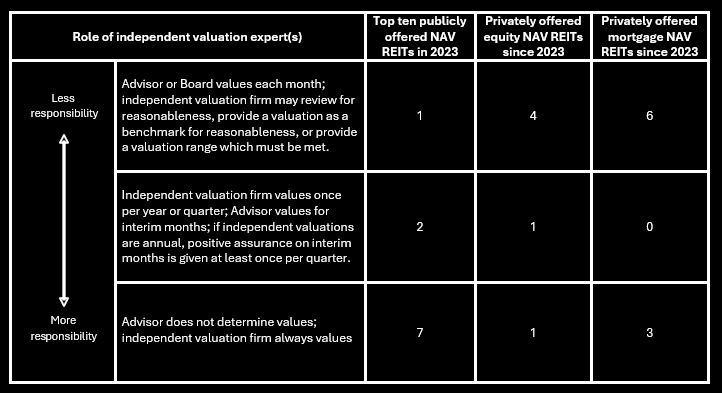
Table includes one privately offered NAV REIT launched in 2022, reflecting an early shift towards private offerings ahead of the broader shift in 2023.
Key observations
· Each of the privately offered NAV REITs included in the review utilizes independent valuation experts, even though their private offerings are not subject to FINRA rules. This practice may enhance investor and distribution partner confidence in the NAV’s reliability.
· The market appears to have accepted a variety of approaches regarding the role and responsibility of the independent valuation expert(s).